
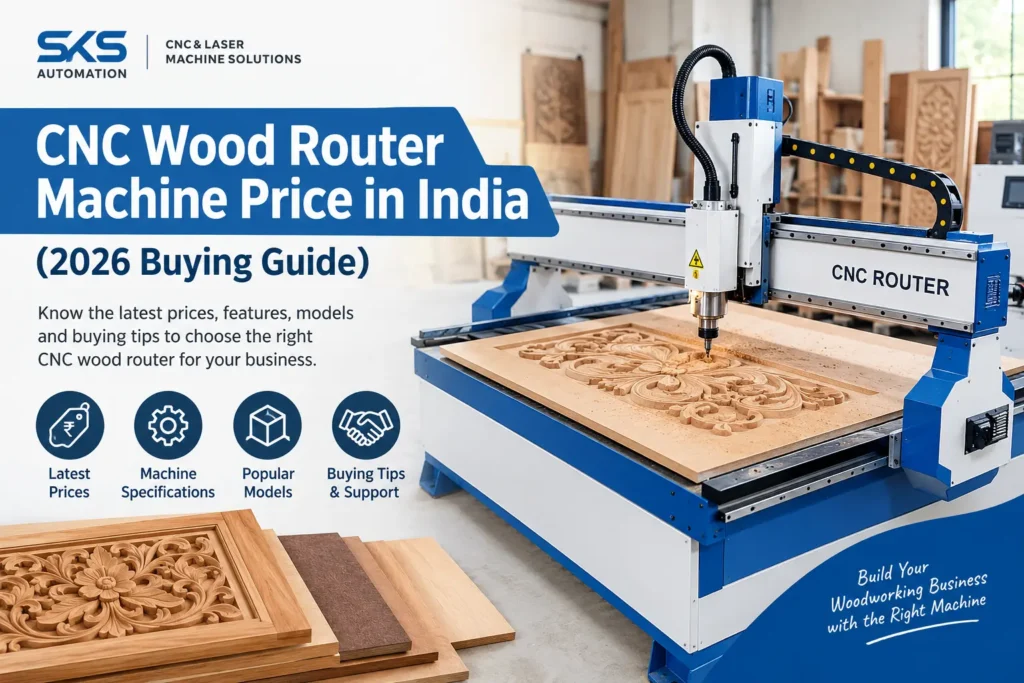
CNC Wood Router Machine Price in India (2026)
The CNC wood router machine price in India depends on the working area, spindle power, machine configuration and automation features. At SKS Automation, different CNC wood router models are available for woodworking workshops, furniture manufacturers, signage businesses and industrial production.
Whether you need a basic 3-axis CNC router for MDF cutting or an advanced ATC CNC router for multi-tool operations, selecting the right configuration can help you manage production costs and improve efficiency.
CNC Wood Router Machine Price List in India
| CNC Wood Router Machine | Listed Price |
|---|---|
| SKS 3-Axis CNC Wood Router | ₹3,00,000 |
| CNC Wood Signage Router | ₹3,50,000 |
| CNC Router Wood Cutting Machine, 3.5 kW | ₹4,00,000 |
| Double Spindle Wood CNC Router, 6 kW | ₹4,10,000 |
| SKS ATC CNC Wood Router | ₹11,00,000 |
| SKS 5-Axis CNC Wood Router | ₹12,00,000 |
Prices are based on the listed prices on the SKS Automation website. Please confirm the latest price, machine specifications, GST, transportation, installation and training charges before placing an order.
The SKS 3-Axis CNC Wood Router at ₹3,00,000 can be a starting point for businesses looking for a general-purpose woodworking machine. Businesses requiring more specialized production can compare the double-spindle, ATC and 5-axis configurations according to their actual requirements.
For detailed specifications and current pricing, visit the CNC Wood Router Machine page at SKS Automation.
Looking for the right CNC wood router for your business? Contact SKS Automation to request a quotation based on your material, working area and production requirements.
1. Small CNC Wood Router Machine: ₹2.5 Lakh–₹4.5 Lakh
A small CNC router is suitable for entrepreneurs who want to start a woodworking or engraving business without investing in a large industrial machine.
It can be used for making wooden nameplates, small decorative products, customized gifts, lettering and selected signage jobs. Its smaller working area limits the size of the products that can be processed in one setup.
Main benefits:
- Lower initial investment than a large industrial router.
- Requires less workshop space.
- Suitable for customized and small-batch orders.
- Helps beginners learn CNC programming and operation.
Who should buy it?
Choose this machine if most of your orders involve small workpieces. If you regularly receive full-size MDF or plywood sheets, consider a 1325 machine before purchasing.
2. 3-Axis CNC Wood Router Machine: ₹3.5 Lakh–₹5.5 Lakh
A standard 3-axis router moves along the X, Y and Z axes. It is commonly used for flat-sheet cutting, engraving, pocketing, drilling and decorative carving.
For a small or medium-sized woodworking workshop, this configuration can handle many everyday jobs without the added expense of specialized automation.
Typical applications include wooden doors, MDF panels, furniture components, cabinet parts and decorative jali designs.
Main benefits:
- Handles a wide range of everyday woodworking operations.
- Repeats programmed designs more consistently than manual tracing and cutting.
- Reduces dependence on manual marking and routing.
- Offers a practical entry point into CNC-based production.
Who should buy it?
It is a good option for businesses that mainly process flat sheets and do not need automatic tool changing or rotary machining.
3. 1325 CNC Wood Router Machine: ₹3.5 Lakh–₹8 Lakh
The 1325 CNC wood router is a popular choice for furniture and interior manufacturing because its typical working area is approximately 1300 × 2500 mm, suitable for many standard 4 × 8 ft sheet-processing applications.
A single-spindle 1325 router can cut MDF, plywood and other compatible sheet materials, depending on the spindle, cutting tool and machine configuration.
It is commonly used for modular kitchens, wardrobes, wooden doors, furniture panels, wall decorations and customized designs.
Main benefits:
- Processes many full-size sheet materials without repeatedly repositioning smaller workpieces.
- Supports different designs using programmed toolpaths.
- Can help reduce layout errors and material waste when jobs are properly nested.
- Provides flexibility to manufacture customized products and repeat orders.
Who should buy it?
Consider a 1325 machine if you want to manufacture furniture components, MDF jali, cabinet panels or decorative doors on a regular basis.
Before buying, check the usable cutting area, Z-axis clearance, spindle power, table type and whether a vacuum pump is included.
4. Double-Spindle CNC Wood Router Machine: ₹6 Lakh–₹9 Lakh
A double-spindle CNC router has two spindle heads that can be configured to process compatible jobs. Depending on the machine design, the heads may work on separate components or perform coordinated operations.
This configuration can be helpful when manufacturing repeated furniture parts or identical decorative panels.
Main benefits:
- Can increase output for suitable repetitive jobs.
- May reduce processing time when two compatible operations can run together.
- Helps businesses handle batch orders more efficiently.
- Can be useful for standardized products manufactured in larger quantities.
Who should buy it?
A double-spindle machine may suit a business producing repeated designs in significant quantities. However, two spindles do not automatically mean double the output. Actual productivity depends on toolpaths, workholding, spindle arrangement, loading time and the type of job.
5. 4-Axis CNC Wood Router Machine: ₹4.5 Lakh–₹8 Lakh
A 4-axis CNC router adds a rotary axis to the usual three linear axes. This allows the machine to rotate suitable workpieces while machining them.
It is particularly useful for woodworking businesses that manufacture cylindrical or curved components rather than only flat panels.
Common applications include decorative pillars, wooden columns, furniture legs, balusters and rotary carvings.
Main benefits:
- Opens up additional product categories.
- Enables suitable rotary designs that are difficult to create on a flatbed machine alone.
- Supports customized and decorative woodworking.
- Can help businesses accept specialized orders with potentially higher selling prices.
Who should buy it?
Choose a 4-axis configuration if rotary carving is part of your regular business plan. If your work mainly involves MDF sheets and modular furniture panels, a standard 3-axis router may be the more economical choice.
6. Servo CNC Wood Router Machine: ₹5.5 Lakh–₹10 Lakh
A servo-driven CNC router uses servo motors and drives to control machine movement. Depending on the system, it can offer advantages in motion response, speed control and performance during demanding production work.
The overall result still depends on the frame, transmission, controller, tuning, tool selection and machine maintenance.
Main benefits:
- Can offer responsive and controlled movement during demanding jobs.
- May be suitable for frequent production cycles.
- Provides an option for businesses upgrading from an entry-level machine.
- Can support more demanding workloads when the complete machine is properly designed.
Who should buy it?
Consider a servo machine if you expect regular production, faster movement or more demanding operating conditions. Compare the actual drive specifications and demonstrate the machine on your own type of material before deciding.
7. ATC CNC Wood Router Machine: ₹8 Lakh–₹15 Lakh+
ATC stands for Automatic Tool Changer. An ATC router can automatically select and change tools during a programmed job, reducing the need for an operator to stop the machine and change tools manually.
For example, a furniture panel may require one tool for drilling, another for cutting and a different tool for finishing or engraving.
An ATC system can make these multi-tool jobs more convenient and consistent.
Main benefits:
- Reduces manual tool-changing interruptions.
- Can improve productivity on multi-tool jobs.
- Helps maintain a more organized production workflow.
- Reduces the risk of selecting the wrong tool during frequent manual changes.
- Can be valuable for cabinet, wardrobe and modular furniture manufacturing.
Who should buy it?
An ATC router is worth considering when you regularly process jobs requiring several different tools. For simple cutting jobs using one tool, a standard single-spindle machine may offer better value for your budget.
Benefits of Buying a CNC Wood Router Machine
Buying a CNC wood router is not just about automating cutting. It can change how a woodworking business designs products, manages labour, handles repeat orders, and grows its customer base.
1. Increase Production Capacity
Manual cutting and carving can take considerable time, particularly when a product contains many curves, holes or decorative details. A CNC router follows programmed toolpaths to perform these operations.
Once a job has been programmed and tested, the same design can be used for additional workpieces. This can reduce repeated manual setup and make production planning easier.
Business benefit: You may be able to complete more suitable orders in the same working day. The actual improvement depends on machining time, loading, unloading, finishing and operator availability.
2. Improve Repeatability and Design Consistency
When several furniture panels must have the same dimensions and hole positions, manual work can introduce small variations.
A CNC router follows programmed coordinates, helping produce consistent results across repeated jobs when the machine is correctly calibrated and maintained.
This is particularly useful for modular kitchens, wardrobes, cabinet doors and furniture components that must fit together accurately.
Business benefit: Consistent components can reduce rework, fitting problems and time spent correcting manufacturing errors.
3. Reduce Manual Work and Dependence on Skilled Hand Routing
Traditional woodworking often requires an experienced operator to trace designs, guide cutting tools and reproduce decorative details.
With CNC machining, the operator prepares the design, sets up the material, selects the correct tools and supervises the programmed process.
CNC does not eliminate the need for skilled workers. Operators still need training in design software, tool selection, workholding, machine setup, maintenance and safety.
Business benefit: Your team can spend less time on repetitive manual routing and more time on design preparation, quality checks, assembly and customer orders.
4. Manufacture Complex Designs
CNC routers can produce intricate patterns, lettering, decorative jali, curved outlines and detailed relief carvings that may be difficult or time-consuming to reproduce manually.
Businesses can use digital designs to create customized products for homes, offices, hotels, retail outlets and commercial interiors.
Business benefit: You can explore more specialized products instead of competing only on the price of standard furniture panels.
Remember that detailed carving requires suitable software, cutters, machining settings and finishing. Not every design can be produced economically on every machine.
5. Reduce Material Waste Through Better Planning
CNC software can arrange multiple parts on a sheet through a process known as nesting. Good nesting can help reduce unused spaces between components.
For example, a manufacturer producing several cabinet parts may arrange them on one sheet before cutting instead of positioning each part individually by hand.
Material savings depend on sheet dimensions, part geometry, grain direction, cutting gaps, defects and the quality of the nesting plan.
Business benefit: Better material utilization can reduce the cost per finished component and improve margins.
6. Handle Customized Orders More Easily
Customers increasingly request furniture in different dimensions, decorative patterns, finishes and layouts.
A CNC router can process updated digital designs without requiring the manufacturer to recreate every shape manually. Once the new design is prepared and checked, the machine can produce the customized parts.
Business benefit: You can accept more made-to-order work, including personalized furniture, decorative panels, custom doors and interior design components.
7. Improve Production Planning
A digital workflow helps businesses keep track of designs, toolpaths, material requirements and repeat jobs.
Instead of relying entirely on handwritten measurements or manual templates, manufacturers can organize digital files and reuse verified programs.
Business benefit: Repeat orders become easier to plan, and operators can work from standardized production files.
However, digital file management and proper revision control are important. Using the wrong design version can still result in wasted material.
8. Expand Your Product Range
A suitable CNC wood router can help a business move into products beyond basic cutting.
Depending on the machine and its capabilities, possible products include:
- Modular kitchen and wardrobe components
- MDF decorative jali and partitions
- Wooden door panels
- Furniture components and decorative mouldings
- Signboards and engraved nameplates
- Customized wall panels
- Selected three-dimensional and rotary carvings
Business benefit: A broader product range can create opportunities to work with furniture manufacturers, carpenters, interior designers, contractors and signage businesses.
9. Improve Quality Control
A CNC router can produce repeatable toolpaths, but consistent quality still depends on the condition of the machine, the cutting tool, the material and the operator’s setup.
Regular calibration, appropriate feed rates, sharp cutters, secure workholding and dust management all contribute to better results.
Business benefit: A controlled production process can reduce avoidable defects and help you deliver orders more consistently.
10. Build a Business That Can Scale
When order volumes increase, manual production may become difficult to manage. A CNC router can help standardize repeated operations and provide a clearer basis for estimating job time and production capacity.
A business may later upgrade its workflow with a vacuum table, better dust extraction, servo drives, a second spindle or ATC, depending on the workload.
Business benefit: You can plan expansion based on actual demand instead of immediately investing in the most expensive machine available.
Is Buying a CNC Wood Router Machine Profitable?
A CNC router can be profitable when there is enough paid work to cover the machine’s running costs and recover the investment. Profit is not guaranteed simply because a machine is automated.
Consider a simplified example for a small woodworking business.
| Monthly Business Calculation | Illustrative Amount |
|---|---|
| Revenue from completed orders | ₹2,50,000 |
| Material and consumables | ₹1,00,000 |
| Operator and other labour | ₹35,000 |
| Electricity and maintenance | ₹15,000 |
| Rent, selling and other overheads | ₹30,000 |
| Estimated operating surplus | ₹70,000 |
These figures are only an illustration, not a forecast or a guaranteed CNC business income. They exclude financing costs, depreciation and taxes, and assume that the listed costs cover the business’s relevant monthly operating expenses.
Your actual results will depend on order volume, selling prices, material wastage, machine utilization, downtime, labour, and competition.
How to Estimate Your Own Return
Before purchasing, calculate:
- Monthly sales: How much revenue can you reasonably expect from confirmed or likely orders?
- Variable costs: How much will materials, cutters, finishing and other job-related expenses cost?
- Fixed costs: What will you spend on rent, salaries, electricity-related charges, service and other overheads?
- Initial investment: Include the machine, GST, transportation, installation, tooling and any required electrical or workshop upgrades.
- Monthly cash flow: Allow for customer payment delays, maintenance and periods with fewer orders.
A useful starting formula is:
Monthly operating surplus = Monthly revenue − Monthly operating expenses
To estimate how long it may take to recover your investment, divide the total initial investment by the expected monthly cash available for recovery. Use a realistic estimate rather than assuming the machine will operate at full capacity from the first month.
How to Choose the Right CNC Wood Router for Your Budget
Before comparing quotations, identify the type of work you want the machine to perform.
| Your Business Requirement | Machine to Consider | Main Buying Priority |
|---|---|---|
| Small decorative products and signs | 6090 or similar small router | Working area and ease of operation |
| MDF and plywood sheet cutting | 1325, 3-axis router | Usable bed size and spindle |
| Furniture and modular kitchens | 1325 CNC wood router | Repeatability and sheet handling |
| High-volume repeated components | Double-spindle configuration | Real output per cycle |
| Rotary carving and wooden pillars | 4-axis CNC router | Rotary capacity and workpiece clearance |
| Frequent multi-tool jobs | ATC CNC router | Tool-change system and software |
| Demanding regular production | Suitable servo-driven router | Frame, drive quality and support |
Ask the supplier to provide a written specification sheet and a complete delivered quotation. Check what is included in the price, especially GST, vacuum pump, dust collector, software, tooling, installation, operator training and warranty.
The best machine is not necessarily the cheapest one or the one with the highest spindle power. It is the machine that can produce your required products at the quality, speed and cost your business needs.
Get a CNC Wood Router Machine Quotation from SKS Automation
If you are planning to start a woodworking business or expand an existing furniture unit, SKS Automation can help you discuss the CNC wood router configuration that matches your production requirements.
Before requesting a quotation, prepare these details:
- Required working area, such as 1300 × 2500 mm
- Material type and maximum thickness
- Main products you plan to manufacture
- Expected production volume
- Preferred spindle and automation features
- Budget and installation location