
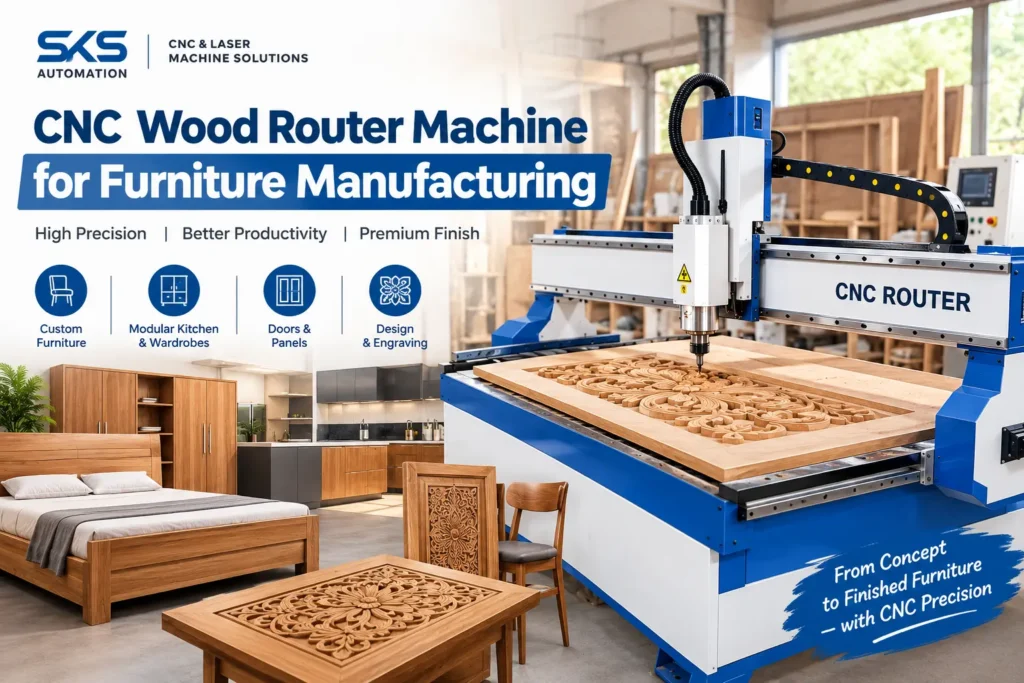
The furniture manufacturing industry in India is changing rapidly. Customers want customized furniture, modern modular kitchens, stylish wardrobes, decorative doors, and precisely finished wooden products. To meet these demands, furniture manufacturers need machines that can produce accurate components, handle repeat orders, and make production more efficient.
A CNC wood router machine is an important investment for businesses that want to improve their woodworking process. It can cut, drill, engrave, and carve designs in materials such as MDF, plywood, and solid wood, depending on the machine configuration and cutting tools.
But which CNC wood router machine is best for furniture manufacturing? Should you choose a standard 3-axis router, a double-spindle machine, or an automatic tool-changing (ATC) CNC router?
In this guide, SKS Automation explains the different types of CNC wood routers, their applications, important features, estimated prices, and how to select a machine for your furniture business.
What Is the Best CNC Wood Router Machine for Furniture Manufacturing?
The best CNC wood router depends on the type of furniture you manufacture, the size of your workpieces, your daily production requirements, and your budget.
For many small and medium-sized furniture manufacturers, a 1325 3-axis CNC wood router is a practical starting point because its typical working area of approximately 1300 × 2500 mm accommodates many standard 4 × 8 ft sheet-processing applications.
For businesses handling larger production volumes or frequent tool changes, a double-spindle or ATC CNC router may be more suitable.
Here is a quick comparison.
| CNC Wood Router Type | Best Application | Main Advantage |
|---|---|---|
| 3-Axis CNC Wood Router | Furniture panels, MDF and plywood | Versatile and economical |
| 1325 CNC Wood Router | Wardrobes, cabinets and modular kitchens | Suitable for many full-size sheets |
| Double-Spindle CNC Router | Repetitive furniture components | Can process compatible jobs with two spindles |
| Servo CNC Wood Router | Regular industrial production | Responsive motion control |
| ATC CNC Wood Router | Multi-tool furniture manufacturing | Automatic tool changes |
| 4-Axis CNC Wood Router | Rotary carving and furniture legs | Additional rotary machining capability |
| 5-Axis CNC Wood Router | Complex three-dimensional components | Multi-directional machining capability |
The right choice depends on your actual manufacturing process. A more advanced machine is not necessarily the best investment if your products require only simple panel cutting.
CNC Wood Router Machine Price for Furniture Manufacturing in India
The price of a CNC wood router varies according to the working area, spindle power, drive system, controller, table configuration, and automation features.
The following prices are listed on the SKS Automation website and can help buyers compare available options.
| CNC Wood Router Machine | Listed Price |
|---|---|
| SKS 3-Axis CNC Wood Router | ₹3,00,000 |
| CNC Wood Signage Router | ₹3,50,000 |
| CNC Router Wood Cutting Machine, 3.5 kW | ₹4,00,000 |
| Double-Spindle Wood CNC Router, 6 kW | ₹4,10,000 |
| SKS ATC CNC Wood Router | ₹11,00,000 |
| SKS 5-Axis CNC Wood Router | ₹12,00,000 |
These are website-listed prices, not guaranteed final quotations. Confirm current availability, working area, specifications, GST, transportation, installation, and training charges with SKS Automation before purchasing.
Explore the SKS Automation Wood CNC Machine range to review the available models.
1. 3-Axis CNC Wood Router: Best for General Furniture Manufacturing
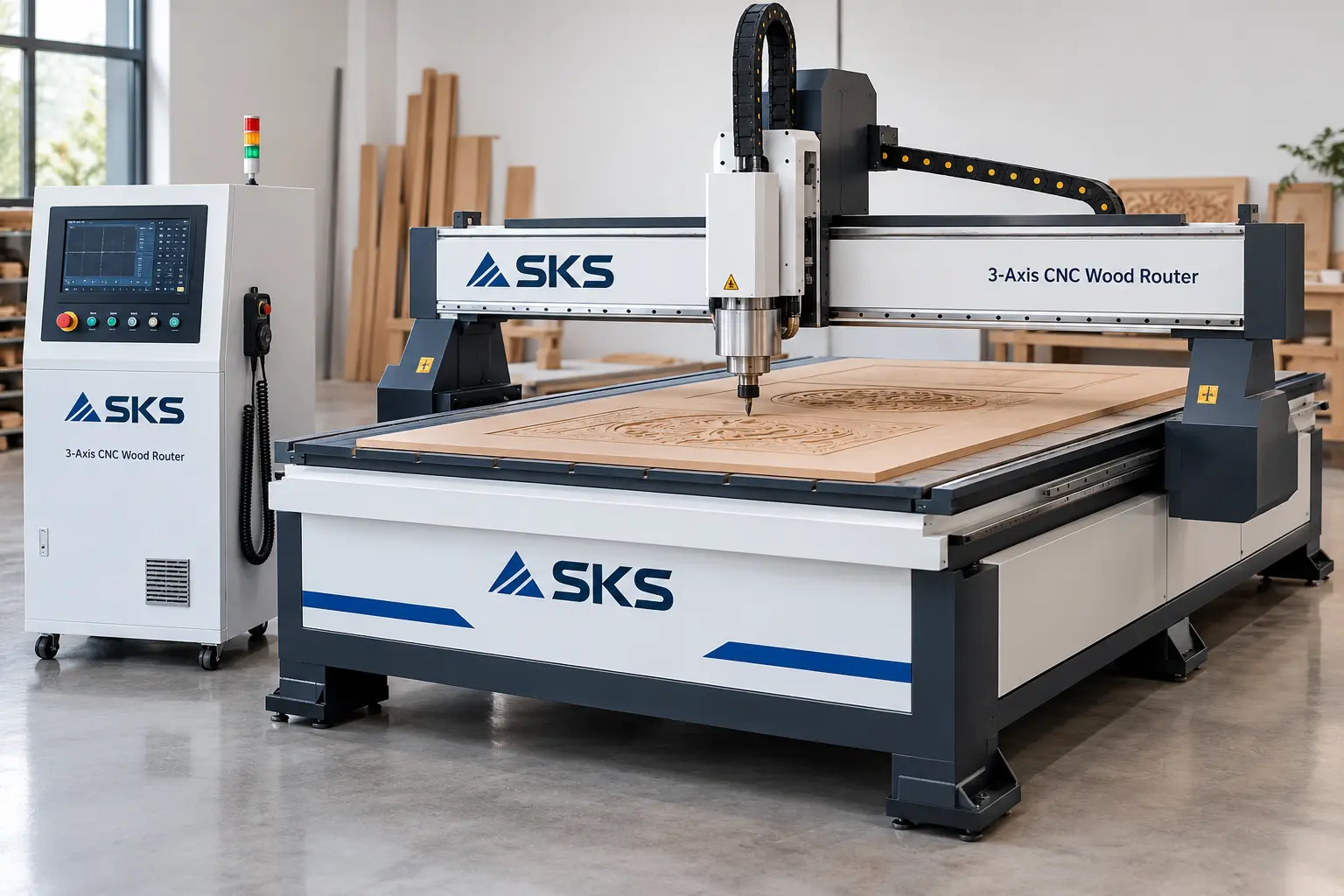
A 3-axis CNC wood router moves along the X, Y, and Z axes. It is suitable for many standard furniture manufacturing operations, including panel cutting, drilling, pocketing, engraving, and decorative carving.
For example, a furniture manufacturer can use a CNC router to produce cabinet doors, wardrobe panels, furniture components, and decorative MDF designs from digital drawings.
Once a program has been checked and the material is properly secured, the machine can repeat the same design across multiple components.
Benefits for furniture manufacturers
- Produces repeatable components from digital designs.
- Reduces manual marking and routing work.
- Supports a wide range of flat-sheet woodworking applications.
- Makes customized designs easier to reproduce.
- Provides a practical entry point for small and medium-sized businesses.
Best for: Furniture workshops, cabinet manufacturers, carpenters, and businesses producing MDF jali, decorative panels, and wooden furniture parts.
2. 1325 CNC Wood Router: Best for MDF, Plywood and Cabinet Panels
A 1325 CNC router typically has a working area of approximately 1300 × 2500 mm. This format is useful for processing many standard sheet materials used in furniture manufacturing.
It can be configured for cutting, engraving, drilling, and carving operations depending on the spindle, controller, table, and tooling.
Common applications include:
- Modular kitchen cabinet panels
- Wardrobe and cupboard components
- MDF decorative jali
- Wooden door panels
- Furniture components and partitions
- Interior decoration panels
Why is a 1325 router useful?
A suitable working area can reduce the need to reposition large sheets repeatedly. With good digital nesting, the operator can arrange multiple components on a sheet before machining.
This can help improve material utilization and standardize production, although actual savings depend on the part designs, sheet quality, cutting gaps, and machine setup.
Buying tip: Before selecting a 1325 machine, confirm its usable cutting area, Z-axis clearance, spindle power, table type, vacuum system, and compatibility with the materials you intend to process.
3. Double-Spindle CNC Wood Router: Best for Repetitive Production
A double-spindle CNC wood router has two spindle heads that can be used for compatible machining operations. Depending on the machine design, the spindles may work on separate components or perform coordinated operations.
This configuration can benefit manufacturers who produce repeated furniture parts or batches of similar designs.
Benefits
- Can increase output for suitable repetitive jobs.
- May reduce machining time when compatible operations can be performed together.
- Supports batch production of furniture components.
- Can help businesses manage larger orders.
However, two spindles do not automatically mean twice the output. Productivity depends on the machine’s configuration, programming, loading and unloading time, workholding, and the type of job.
Best for: Businesses manufacturing repeated furniture components, decorative panels, and similar parts in batches.
4. ATC CNC Wood Router: Best for Advanced Furniture Manufacturing
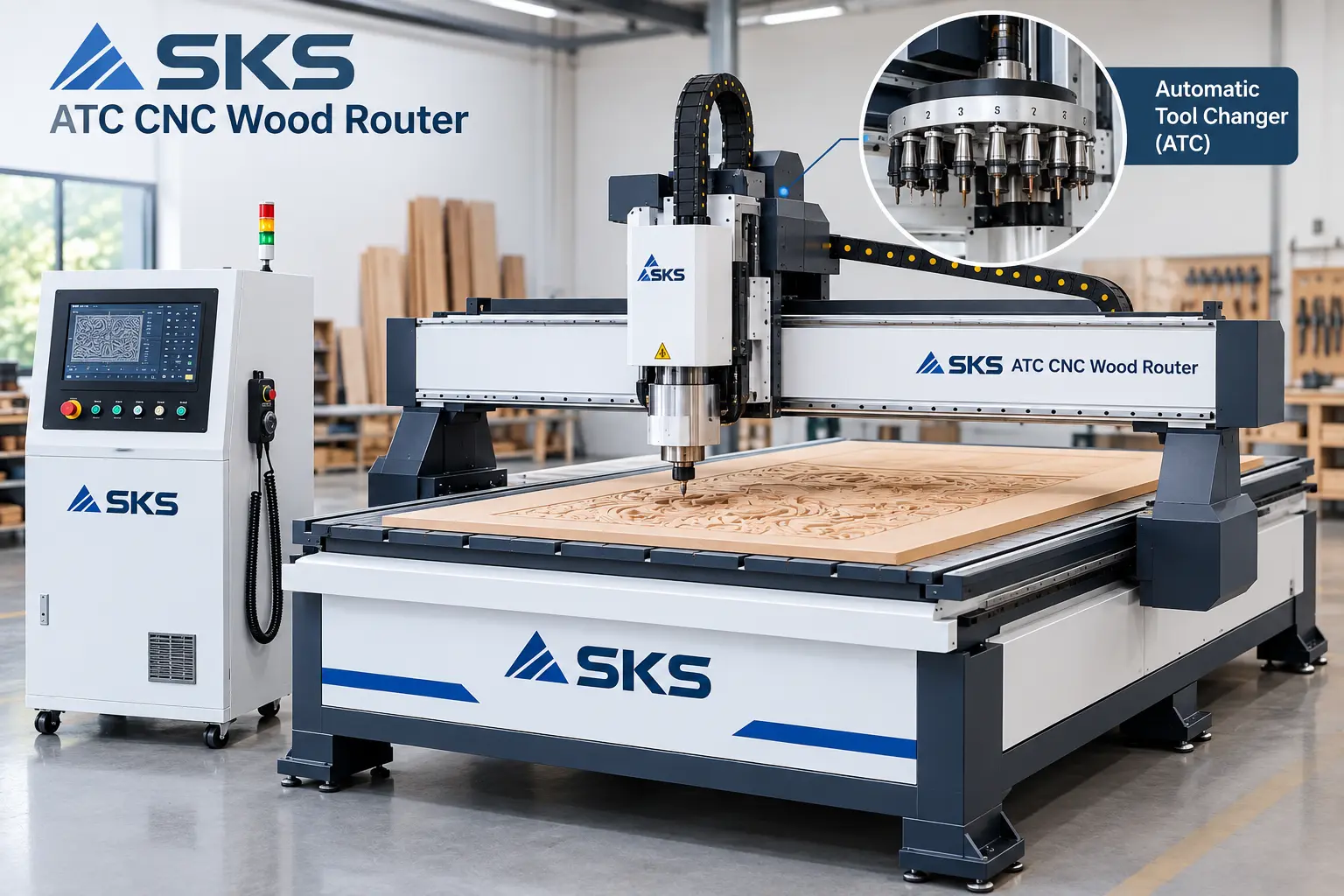
ATC stands for Automatic Tool Changer. An ATC CNC router can automatically change tools during a programmed job, allowing different machining operations to be completed without repeated manual tool changes.
For example, a cabinet component may require drilling, cutting, and engraving. With a properly configured ATC machine, these operations can be included in one programmed workflow using the appropriate tools.
Benefits of an ATC CNC router
- Reduces interruptions caused by manual tool changes.
- Supports jobs requiring multiple cutting tools.
- Can improve workflow consistency.
- Helps reduce operator involvement in repetitive tool-changing tasks.
- Can be valuable for more complex furniture production.
An ATC machine generally costs more than a basic router. It is worth considering when the time saved through automation is valuable enough to justify the additional investment.
Best for: Furniture factories, modular kitchen manufacturers, wardrobe manufacturers, and businesses processing multi-operation jobs regularly.
5. 4-Axis and 5-Axis CNC Routers for Specialized Furniture
Most furniture panel cutting can be handled with a suitable 3-axis router. However, some products require rotary machining or tool movement in additional directions.
A 4-axis CNC router adds a rotary axis and can be useful for cylindrical wooden components, furniture legs, pillars, and decorative carvings.
A 5-axis CNC router offers additional movement capabilities that can support complex three-dimensional machining, depending on the machine design and software.
When should you choose these machines?
Consider 4-axis or 5-axis machining if your business specializes in complex furniture parts, sculpted components, curved surfaces, or products that cannot be manufactured efficiently using a standard 3-axis machine.
For ordinary cabinet panels and modular furniture components, a 3-axis or ATC router may be a more economical option.
Important Features to Check Before Buying a CNC Wood Router
Choosing a machine only by its price can lead to unnecessary expenses or production limitations. Review these specifications before purchasing.
1. Working Area
Select a working area that accommodates your largest regular workpiece. If you manufacture furniture from standard MDF and plywood sheets, check the usable cutting dimensions rather than relying only on the model name.
2. Spindle Power
Spindle power affects the machine’s ability to perform different machining operations with suitable tools and settings. The appropriate power depends on the material, cutter, cutting depth, feed rate, and workload.
A higher-power spindle is not automatically better for every furniture application.
3. Drive System
Stepper-driven machines may suit many budget-conscious applications. Servo-driven systems can offer advantages in motion response and control for demanding production environments.
Compare the complete machine specifications and test the performance on representative workpieces.
4. Table Configuration
A T-slot table allows mechanical workholding, while a vacuum table can help secure suitable sheet materials. The right option depends on the size, thickness, and type of material being processed.
5. CNC Controller and Software
The controller and software determine how designs are converted into machine movements. Check file compatibility, ease of operation, available training, and support for your intended machining operations.
6. Dust Collection
Woodworking produces dust and chips. A suitable dust extraction system helps keep the working area cleaner and supports effective machine maintenance. Ensure that the extraction arrangement matches the machine and the materials being processed.
7. Installation and After-Sales Support
Ask the supplier about delivery, installation, operator training, warranty coverage, spare parts, and technical support. These services can affect the machine’s overall value over its working life.
Benefits of Using CNC Wood Router Machines in Furniture Manufacturing
Improved production efficiency
A CNC router follows programmed toolpaths instead of relying entirely on manual marking and cutting. Once a job is set up, repeated components can be manufactured with less repeated manual intervention.
This can make it easier to plan production schedules and handle repeat orders.
Better consistency between components
Furniture often contains parts that must fit together accurately. A calibrated CNC router can repeat programmed dimensions and hole positions, helping reduce variations between components.
The result still depends on the machine’s condition, tooling, material quality, and correct setup.
Lower material waste through better nesting
Nesting software can arrange furniture parts on sheets to reduce unused spaces. Better material planning can lower the material cost per component and help control production expenses.
Actual savings depend on part geometry, sheet defects, cutting gaps, and the operator’s nesting strategy.
More design flexibility
CNC machining allows manufacturers to produce customized patterns, decorative panels, engraved details, and different product sizes using digital designs.
This makes it easier to accommodate customer preferences without creating a new manual template for every variation.
Reduced repetitive manual work
The machine handles programmed cutting and carving while the operator prepares materials, monitors the process, checks quality, and manages subsequent jobs.
CNC automation does not eliminate the need for skilled workers, but it can change how their time is used.
Opportunities to expand your business
A suitable CNC router can help a furniture business offer additional products such as decorative jali, customized doors, cabinet panels, wall decorations, and selected carved components.
This may open opportunities to work with interior designers, contractors, furniture retailers, and other manufacturers.
How to Calculate the Return on Investment
A CNC wood router can support business growth, but profitability depends on paid orders, machine utilization, production costs, and selling prices.
Before purchasing, estimate the following:
- Monthly sales from expected orders.
- Material and cutting-tool costs.
- Operator salaries and other labour costs.
- Electricity, maintenance, rent, and overheads.
- Initial machine investment and installation expenses.
- Financing costs, depreciation, and taxes where applicable.
A simple starting formula is:
Monthly operating surplus = Monthly revenue − Monthly operating expenses
For example, if a furniture workshop earns ₹3,00,000 in monthly revenue and spends ₹2,40,000 on its operating expenses, the illustrative monthly operating surplus would be ₹60,000 before any excluded financing costs, depreciation, and taxes.
This is only an example, not a guaranteed income estimate. Actual results depend on order volume, machine downtime, material wastage, labour, and local market conditions.
Before investing, calculate your expected production capacity and confirm that you have a realistic route to securing enough orders.
How to Choose the Right CNC Wood Router for Your Furniture Business
Use this simple guide to narrow down your options.
| Your Requirement | Machine to Consider |
|---|---|
| Starting a small furniture workshop | 3-axis CNC wood router |
| Cutting MDF and plywood sheets | 1325 CNC wood router |
| Producing repeated components | Double-spindle CNC router |
| Manufacturing multi-tool cabinet components | ATC CNC wood router |
| Making rotary-carved furniture parts | 4-axis CNC router |
| Producing complex 3D components | 5-axis CNC router |
Before finalizing a model, ask the supplier to demonstrate a representative job using your material and design. Check the finished edges, hole positions, machining time, tool changes, and ease of operation.
Also request a written quotation that clearly identifies the machine configuration and all additional charges.
Why Choose SKS Automation for CNC Wood Router Machines?
SKS Automation provides CNC and laser machine solutions for businesses looking to improve their manufacturing capabilities.
When comparing CNC wood router options, discuss your working area, spindle power, material thickness, production volume, and automation requirements with the team.
SKS Automation lists different wood CNC router configurations, including 3-axis, double-spindle, ATC, and 5-axis options, allowing buyers to compare machines according to their production needs.
Explore the SKS Automation Wood CNC Machine range to review listed models and prices.
Before purchasing, confirm the exact specifications, delivery timeline, installation arrangements, operator training, warranty, and after-sales support.
Frequently Asked Questions
Which CNC wood router is best for furniture manufacturing?
A 3-axis 1325 CNC wood router is a practical option for many furniture manufacturers working with MDF and plywood sheets. Businesses that need automatic tool changes or higher-volume production may benefit from an ATC configuration.
What is the price of a CNC wood router machine in India?
The price depends on the machine type, working area, spindle, drive system, and automation features. SKS Automation lists a 3-axis CNC wood router at ₹3,00,000 and an ATC CNC wood router at ₹11,00,000. Confirm current prices and specifications before ordering.
Can a CNC wood router manufacture modular kitchen cabinets?
Yes. A suitably configured CNC router can cut and machine cabinet panels, wardrobe components, and other furniture parts from compatible sheet materials. The complete production process may also require edge banding, assembly, and finishing equipment.
Is an ATC CNC router worth the investment?
An ATC router can be useful when your jobs require frequent changes between drilling, cutting, and other tools. For simple operations requiring one tool, a standard CNC router may be more economical.
Can a CNC router cut MDF and plywood?
Yes. A suitably configured router can process MDF and plywood using compatible cutting tools and appropriate machining settings. Cutting quality depends on the machine, tooling, material, and operating parameters.
What should I check before buying a CNC wood router?
Check the working area, spindle power, drive system, controller, table type, dust extraction, tooling, installation, warranty, and after-sales support. Ask for a demonstration on your intended material before making a decision.
Get a CNC Wood Router Machine Quotation from SKS Automation
Looking for the best CNC wood router machine for your furniture manufacturing business?
Compare the available models, identify your production requirements, and select a machine that fits your budget and expected workload.
Contact SKS Automation
Website: https://sksautomation.in/wood-cnc-machine/
Phone/WhatsApp: +91 7727987985
Email: sksautomation11@gmail.com
Request a quotation to discuss machine specifications, pricing, installation, operator training, warranty, and technical support.
Invest in the right CNC wood router to improve production consistency, expand your product range, and support the long-term growth of your furniture business.