
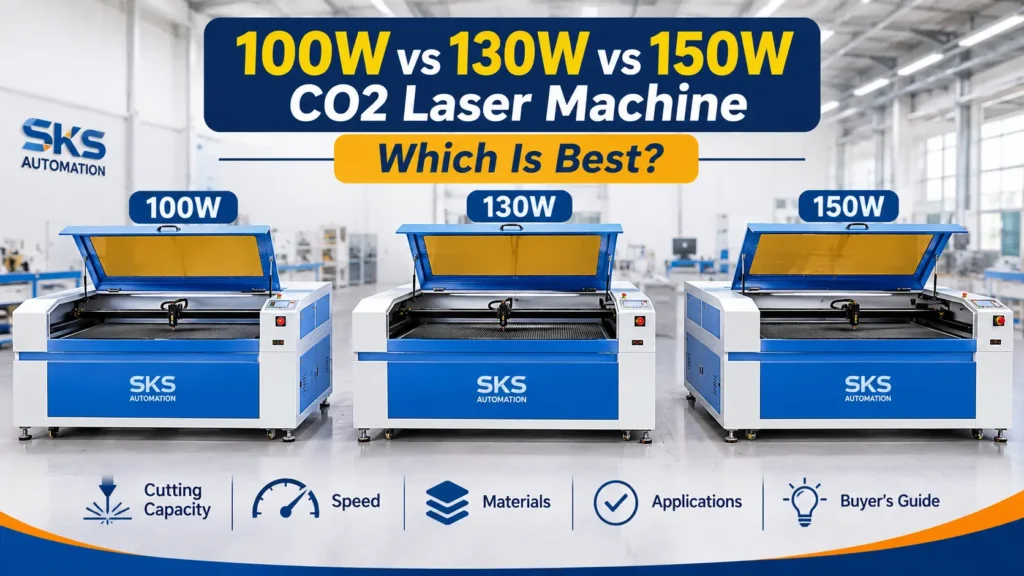
Choosing the right CO2 laser cutting machine is an important decision for businesses working with acrylic, MDF, plywood, wood, leather, and other non-metallic materials. One of the most common questions buyers face is whether to purchase a 100W, 130W, or 150W CO2 laser machine.
Although these machines use similar laser technology, their cutting capabilities, production speeds, and suitability for different applications can vary significantly.
A 100W machine can be a practical choice for businesses handling regular engraving and light-to-medium cutting jobs. A 130W machine offers additional power for businesses with increasing production requirements, while a 150W machine is worth considering for operations that frequently cut thicker materials or require higher production throughput.
However, higher wattage does not automatically mean better performance. The laser tube, working area, optical components, cooling system, motion system, and material quality all influence the final result.
In this guide, we compare 100W vs 130W vs 150W CO2 laser machines to help you select the right equipment for your business.
1. Understanding CO2 Laser Machine Wattage
A CO2 laser cutting machine uses a carbon dioxide laser source to generate an infrared laser beam, typically at a wavelength of 10.6 micrometers.
The beam is directed through mirrors and a focusing lens to cut or engrave materials.
The wattage indicates the output power of the laser source. Generally, a higher-powered laser tube provides greater cutting capability and can process certain materials faster.
For example:
- 100W CO2 Laser Machine: Suitable for engraving and regular cutting applications involving acrylic, MDF, plywood, and wood.
- 130W CO2 Laser Machine: Suitable for businesses requiring more cutting power and improved production capability.
- 150W CO2 Laser Machine: Suitable for production-oriented applications involving thicker materials and demanding cutting requirements.
It is important to check whether the advertised wattage represents the tube’s rated output or maximum output. Always request the manufacturer’s exact tube model and technical datasheet before purchasing.
2. 100W vs 130W vs 150W CO2 Laser Machine: Quick Comparison
The following table explains the general differences between the three power options.
| Specification | 100W | 130W | 150W |
|---|---|---|---|
| Laser power | 100W | 130W | 150W |
| Cutting capability | Light-to-medium applications | Medium-to-heavy applications | More demanding cutting applications |
| Engraving | Yes | Yes | Yes |
| Acrylic cutting | Yes | Yes | Yes |
| MDF cutting | Yes | Yes | Yes |
| Plywood cutting | Yes | Yes | Yes |
| Wood engraving | Yes | Yes | Yes |
| Leather cutting | Yes | Yes | Yes |
| Production suitability | Small to medium | Medium to high | Higher-volume production |
| Investment | Generally lower | Generally moderate | Generally higher |
Note: This is a general comparison, not a guaranteed specification for every machine. Actual performance depends on the laser tube, material grade, thickness, optics, focus, air assistance, cooling, and machine configuration.
3. 100W CO2 Laser Cutting Machine: Best for Small and Medium Businesses

A 100W CO2 laser cutting machine is a practical starting point for businesses that need a combination of engraving and cutting capabilities.
It can process various non-metallic materials, making it useful for customized products, signage, decorative items, and small manufacturing operations.
Key Applications of a 100W CO2 Laser Machine
1. Acrylic Cutting and Engraving
A 100W machine can cut acrylic sheets and engrave designs for nameplates, signage, display products, and customized decorative items.
2. MDF Cutting
Businesses manufacturing MDF decorative products, partitions, small furniture components, and customized designs can use a 100W CO2 laser machine.
3. Wooden Product Manufacturing
It is useful for cutting and engraving wooden gift items, photo frames, decorative panels, and customized products.
4. Leather Cutting
A CO2 laser can process suitable leather materials for wallets, accessories, patterns, and customized designs. Material compatibility should always be tested before production.
Advantages of a 100W Machine
- Suitable for a wide range of engraving applications.
- Handles regular cutting requirements.
- Can be a practical investment for smaller workshops.
- Offers flexibility for customized production.
- Generally requires a lower initial investment than higher-powered configurations.
Who Should Buy a 100W CO2 Laser Machine?
A 100W machine is worth considering if you:
- Are starting an acrylic or laser engraving business.
- Manufacture customized wooden products.
- Produce MDF decorative items.
- Handle small and medium production orders.
- Do not regularly need to cut thicker materials.
If most of your work involves engraving and cutting relatively thin sheets, a 100W machine may provide sufficient capability without paying for additional power you rarely use.
4. 130W CO2 Laser Cutting Machine: A Balanced Option for Growing Production

A 130W CO2 laser cutting machine is suitable for businesses that have regular cutting requirements and want additional power compared with a 100W configuration.
It offers greater cutting potential and can help improve production efficiency when processing suitable materials.
For example, a business manufacturing acrylic signage may initially handle smaller sheets and thinner materials. As customer orders increase, the need to process larger batches or thicker sheets can become more important.
A 130W machine can be a suitable upgrade when the production requirements justify the additional investment.
Key Applications of a 130W CO2 Laser Machine
1. Acrylic Signage Manufacturing
It can be used for manufacturing acrylic letters, promotional displays, signage boards, and decorative products.
2. MDF Decorative Products
Suitable applications include MDF jali designs, decorative wall panels, customized partitions, and interior decoration components.
3. Plywood Cutting
Businesses producing customized plywood designs, craft products, and decorative components can benefit from a higher-powered laser source.
4. Commercial Engraving
A 130W machine can handle engraving requirements involving wood, acrylic, leather, and other compatible materials.
Advantages of a 130W CO2 Laser Machine
- Greater cutting potential than a comparable 100W configuration.
- Suitable for growing manufacturing operations.
- Useful for businesses handling regular cutting orders.
- Can improve cutting throughput when the machine is properly configured.
- Provides flexibility for different non-metallic materials.
Who Should Buy a 130W CO2 Laser Machine?
Consider a 130W machine if you:
- Run an established laser cutting business.
- Manufacture acrylic letters and signage.
- Regularly cut MDF and plywood.
- Need additional cutting capacity.
- Want to expand your production capabilities.
For businesses moving beyond occasional cutting jobs, 130W can be a practical middle-ground option.
5. 150W CO2 Laser Cutting Machine: Designed for Demanding Cutting Applications

A 150W CO2 laser cutting machine is designed for applications where higher cutting power and production throughput are important.
It can be particularly useful for businesses processing thicker acrylic, MDF, plywood, and other compatible materials.
However, the real benefit depends on the machine’s complete configuration. A powerful laser tube cannot deliver consistent production results without appropriate cooling, optics, air assistance, extraction, and motion control.
Key Applications of a 150W CO2 Laser Machine
1. Thick Acrylic Cutting
A 150W laser source can be suitable for businesses regularly processing thicker acrylic sheets. The required cutting speed and edge finish should be confirmed through an actual material test.
2. MDF and Plywood Manufacturing
It can support the production of decorative panels, customized furniture components, jali designs, and other wooden products.
3. Large-Batch Production
Manufacturers handling repeat orders may benefit from the additional cutting capacity, particularly when production time is an important consideration.
4. Commercial Signage
A 150W machine can be considered for businesses manufacturing acrylic signage, display boards, customized letters, and decorative advertising products.
Advantages of a 150W CO2 Laser Machine
- Higher available laser output.
- Greater potential for cutting thicker compatible materials.
- Useful for production-focused businesses.
- Suitable for demanding cutting applications.
- More flexibility when processing a wider range of material thicknesses.
Who Should Buy a 150W CO2 Laser Machine?
A 150W configuration may be the right choice if you:
- Regularly process thicker acrylic sheets.
- Manufacture MDF and plywood products in larger batches.
- Have consistent commercial cutting orders.
- Need additional production capacity.
- Plan to expand your manufacturing operations.
If your daily workload mainly involves thin acrylic engraving, purchasing a 150W machine may not provide enough additional value to justify the higher investment.
6. Cutting Thickness: How Much Material Can Each Machine Cut?
Cutting thickness is one of the most important considerations when comparing CO2 laser machines.
However, there is no single cutting-thickness specification that applies to every 100W, 130W, or 150W machine.
Different materials respond differently to laser energy.
For example, acrylic can often be cut more easily than certain hardwoods of the same thickness. MDF and plywood also vary depending on their density, adhesive composition, moisture content, and manufacturing quality.
The following factors influence cutting performance:
- Actual rated laser tube output.
- Material type and thickness.
- Focal length and lens condition.
- Laser beam alignment.
- Cutting speed and power settings.
- Air-assist pressure and nozzle configuration.
- Cooling system performance.
- Material flatness and consistency.
Why Maximum Cutting Thickness Is Not Always the Best Measurement
Suppose a machine can cut a particular acrylic sheet at a very slow speed. That does not necessarily mean it can process the same thickness efficiently during daily production.
There is an important difference between:
Maximum cutting thickness: The greatest thickness a machine can cut under specific test conditions.
Recommended production thickness: The material thickness a machine can process consistently at a commercially practical speed and acceptable edge quality.
Before purchasing, ask the manufacturer to demonstrate your actual material thickness and provide a sample cut.
Do not select a machine based only on the maximum thickness mentioned in a product brochure.
7. Cutting Speed: Is 150W Always Faster Than 100W?
Higher laser power can increase cutting speed under comparable conditions, but the improvement is not always proportional to the wattage difference.
For example, moving from 100W to 150W does not guarantee a 50% increase in production speed.
Several other factors affect cutting performance:
- Laser tube quality: The actual output and stability of the tube influence cutting results.
- Motion system: The motors, drive system, and machine structure affect movement and acceleration.
- Optical components: Mirrors and focusing lenses influence how effectively laser energy reaches the material.
- Material quality: Different acrylic, MDF, and plywood sheets can require different settings.
- Machine condition: Alignment, maintenance, and cooling affect consistent performance.
For businesses, the most useful comparison is not simply laser wattage. It is the time required to complete the same job with an acceptable cutting finish.
Ask your supplier to run the same design on the machines you are comparing and record the actual production time.
8. 100W vs 130W vs 150W: Which Machine Is Best for Different Materials?
The right laser power depends on your primary application.
| Material / Application | Recommended starting consideration |
|---|---|
| Thin acrylic engraving | 100W may be sufficient |
| Regular acrylic cutting | 100W or 130W |
| Thicker acrylic cutting | 130W or 150W |
| MDF decorative designs | 100W or 130W |
| Higher-volume MDF cutting | 130W or 150W |
| Plywood cutting | Depends on thickness and grade |
| Wooden engraving | 100W can be sufficient |
| Commercial mixed-material production | 130W or 150W |
These are purchasing recommendations, not guaranteed cutting limits. Request a production sample before finalizing your machine.
Important material safety note: Never laser-cut PVC, vinyl, or unidentified plastics. They can release hazardous and corrosive gases. Verify material compatibility before processing any new material.
9. Important Factors to Check Before Purchasing a CO2 Laser Machine
Choosing between 100W, 130W, and 150W is only one part of the purchasing decision.
A complete CO2 laser cutting machine should be evaluated based on its components and overall configuration.
1. Laser Tube Brand and Model
Ask for the laser tube manufacturer, exact model number, rated power, maximum power, and warranty terms.
Do not rely only on the wattage printed in the machine advertisement.
2. Working Area
Select a working area based on the dimensions of the sheets you normally process.
For example, businesses handling smaller customized products may not need the same working area as manufacturers processing larger MDF or acrylic sheets.
3. Laser Power Supply
The laser power supply must be compatible with the selected tube.
An unsuitable power supply can affect performance and reliability.
4. Cooling System
CO2 laser tubes require appropriate temperature control.
Select a cooling system according to the tube manufacturer’s recommendations and operating conditions. Check whether it includes temperature monitoring and water-flow protection.
5. Motion and Control System
Check the controller, motor configuration, machine movement, software compatibility, and positioning performance.
A reliable motion system is important for consistent cutting and engraving results.
6. Air Assist and Exhaust System
Air assistance helps remove debris from the cutting area and can improve cutting consistency.
A suitable exhaust system is also important for removing smoke and fumes generated during laser processing.
7. Installation and After-Sales Support
Before buying, confirm whether the supplier provides:
- Machine installation.
- Operator training.
- Machine operation guidance.
- Maintenance support.
- Spare parts availability.
- Warranty coverage.
- Technical assistance after installation.
These services can make a significant difference to the long-term operation of your machine.
10. Which CO2 Laser Machine Is Best for Your Business?
Here is a simple way to narrow down your options.
Choose 100W if:
Your business mainly handles engraving, customized products, regular acrylic cutting, and small-to-medium production orders.
Choose 130W if:
You regularly process acrylic, MDF, and plywood and need additional cutting capacity for growing production requirements.
Choose 150W if:
Your business focuses on higher-volume cutting, thicker compatible materials, and demanding commercial production applications.
The best machine is the one that meets your actual production requirements without unnecessary investment.
If you are unsure, prepare a list of your materials, sheet dimensions, maximum routine thickness, and daily production requirements. Share these details with your machine supplier before requesting a quotation.
11. Why Choose SKS Automation for CO2 Laser Cutting Machines?
SKS Automation provides CNC and laser machine solutions for businesses and manufacturing requirements across India.
We understand that different businesses have different cutting, engraving, and production needs. Therefore, selecting the correct machine configuration is important before making an investment.
SKS Automation offers CO2 laser cutting machine solutions for applications involving:
- Acrylic cutting and engraving.
- MDF cutting and decorative designs.
- Wooden product manufacturing.
- Plywood cutting and engraving.
- Customized signage and display manufacturing.
- Industrial and commercial laser applications.
Our team can help you evaluate machine power, working area, application requirements, and suitable configurations.
Whether you are considering a 100W, 130W, or 150W CO2 laser machine, we can help you identify a suitable solution for your business.
Explore our CO2 Laser Cutting Machines:
https://sksautomation.in/product-category/co2-laser-cutting-machine/
Visit SKS Automation:
Contact our team to discuss your application and request a machine quotation.
12. Frequently Asked Questions About 100W, 130W, and 150W CO2 Laser Machines
Q1. What is the main difference between 100W, 130W, and 150W CO2 laser machines?
The main difference is the available laser output power. Higher-powered machines generally provide greater cutting potential and can improve production speed under comparable conditions. The actual difference depends on the tube, optics, material, and machine configuration.
Q2. Is a 100W CO2 laser machine suitable for a small business?
Yes. A 100W CO2 laser machine can be suitable for small businesses manufacturing acrylic signage, wooden products, MDF decorative items, customized gifts, and engraved products.
Q3. Is a 130W CO2 laser machine better than a 100W machine?
A 130W machine offers higher available laser power and may provide better cutting performance for demanding applications. However, a 100W machine may be more economical when most jobs involve thin materials or engraving.
Q4. What are the advantages of a 150W CO2 laser machine?
A 150W machine provides greater laser output, which can be useful for cutting thicker compatible materials and improving production throughput. It is particularly worth considering for businesses with regular commercial cutting requirements.
Q5. Can a CO2 laser machine cut MDF?
Yes. CO2 laser machines can cut and engrave suitable MDF sheets. Results depend on MDF thickness, density, adhesive composition, laser power, and cutting settings.
Q6. Can a CO2 laser machine cut acrylic?
Yes. CO2 laser machines are widely used for cutting and engraving acrylic. The appropriate wattage depends on acrylic thickness, required edge quality, and production speed.
Q7. Which is better for MDF cutting: 100W or 150W?
Both can process suitable MDF materials. A 100W machine may be sufficient for thinner sheets and smaller jobs, while a 150W configuration may be more appropriate when thicker materials or higher production throughput are required.
Q8. Does higher wattage improve engraving quality?
Not necessarily. Engraving quality depends on factors such as laser control, focus, lens selection, motion accuracy, resolution, material, and settings. Higher wattage does not automatically produce finer engraving details.
Q9. What should I check before buying a CO2 laser machine?
Check the actual rated tube power, tube brand, working area, laser power supply, cooling system, controller, lens, air assistance, exhaust system, warranty, installation, and technical support.
Q10. How do I choose the right CO2 laser machine for my business?
Identify the materials you process, their routine thickness, required cutting quality, sheet dimensions, and daily production volume. Compare machine configurations using actual sample cutting tests before purchasing.
Conclusion: Make the Right Investment in a CO2 Laser Machine
The choice between a 100W, 130W, and 150W CO2 laser cutting machine depends on your business requirements.
A 100W machine is a practical option for engraving and regular cutting applications. A 130W machine offers additional cutting capability for growing businesses, while a 150W machine is worth considering for demanding production environments.
Before purchasing, compare the complete machine configuration rather than focusing only on wattage.
The right CO2 laser machine should deliver consistent cutting quality, suitable production speed, reliable operation, and long-term value for your business.