
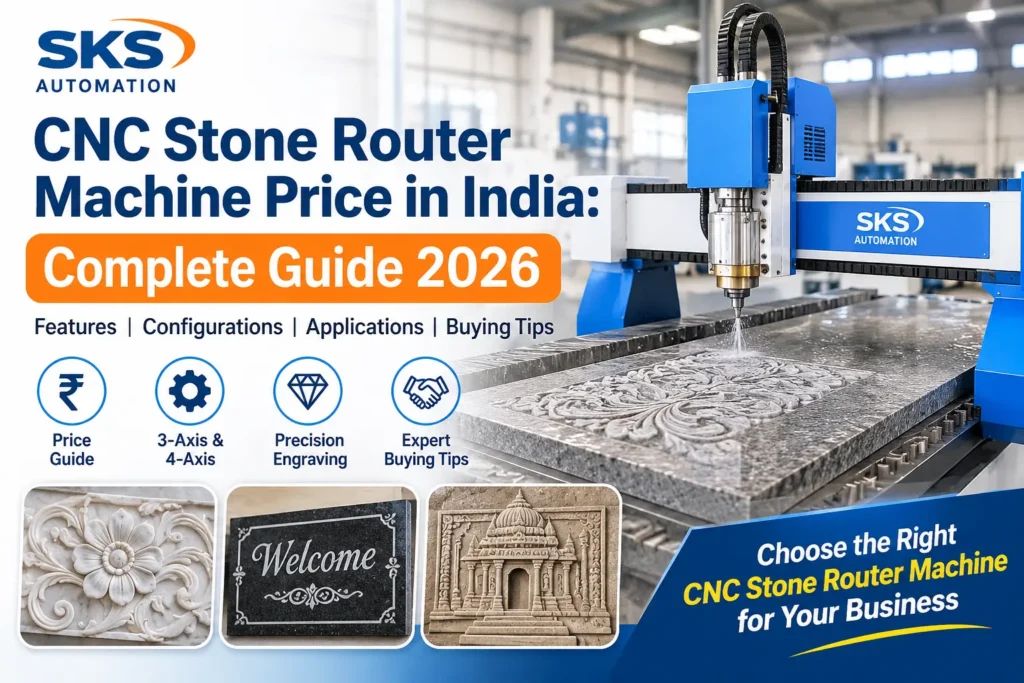
Are you planning to start a stone engraving business or upgrade your existing marble and granite manufacturing setup? Investing in a CNC stone router machine can help you manufacture decorative stone products, engraved nameplates, architectural panels, customized designs, and detailed stone carvings.
However, one of the first questions buyers ask is: What is the CNC Stone Router Machine Price in India?
The price depends on several factors, including machine working area, spindle power, number of axes, machine structure, cooling system, control system, and automation level.
A basic stone engraving configuration and a heavy-duty CNC stone router designed for demanding granite applications will not have the same price.
In this guide, we explain CNC stone router machine prices in India, different machine configurations, technical specifications, applications, and important factors to consider before purchasing.
Whether you are a stone fabricator, marble manufacturer, granite processor, or someone planning to start a new business, this guide will help you make an informed purchasing decision.
1. What Is a CNC Stone Router Machine?
A CNC stone router machine is a computer-controlled machine designed for cutting, engraving, carving, and shaping stone materials.
It uses a rotating spindle with specialized diamond cutting tools to process materials such as:
- Granite
- Marble
- Sandstone
- Quartz
- Natural stone
- Artificial stone
- Ceramic tiles
The machine follows programmed instructions to create accurate designs and repeatable patterns.
Unlike manual stone carving, a CNC stone router can execute complex designs using CAD/CAM software and programmed toolpaths.
What Can You Manufacture with a CNC Stone Router?
A CNC stone router can be used to manufacture:
- Marble nameplates
- Granite nameplates
- Stone wall panels
- Decorative marble designs
- Temple and religious carvings
- Granite kitchen components
- Stone lettering and logos
- Memorial stones
- Decorative architectural elements
- Customized stone engravings
The machine configuration should be selected according to the material, product dimensions, required depth, and production volume.
2. CNC Stone Router Machine Price in India
The CNC stone router machine price in India varies according to the machine’s working area, spindle configuration, mechanical construction, and automation features.
Based on publicly advertised Indian supplier listings, several 3-axis stone router configurations are listed around ₹5.5 lakh to ₹8.5 lakh. Larger and more specialized configurations can be advertised above ₹10 lakh.
The following table provides an indicative market-oriented purchasing guide.
| Machine Configuration | Indicative Price Range |
|---|---|
| Entry-level stone CNC router | ₹4.5–6.5 lakh |
| Standard 3-axis CNC stone router | ₹5.5–8.5 lakh |
| Heavy-duty CNC stone router | ₹8–11 lakh |
| Large-format stone CNC router | ₹10–15 lakh+ |
| Double-spindle CNC stone router | ₹9–14 lakh+ |
| Customized 4-axis stone router | Quotation based |
Important: These are indicative budgeting ranges, not fixed manufacturer quotations. Actual prices depend on the machine specifications, supplier, included accessories, taxes, transportation, installation, and customization.
Always request a detailed quotation with a complete technical specification sheet.
What Determines the CNC Stone Router Machine Price?
Several technical and commercial factors influence the final machine price.
1. Working Area
The working area determines the maximum job dimensions the machine can accommodate.
Common configurations include:
- 1300 × 2500 mm
- 1500 × 3000 mm
- 2000 × 3000 mm
- Customized large-format working areas
A larger working area generally requires a bigger machine structure, longer guideways, and additional mechanical support.
2. Spindle Power
Spindle power is important when processing hard materials such as granite and quartz.
Common industrial stone-router configurations may use 3.5 kW, 5.5 kW, 6 kW, or 7.5 kW spindles.
The appropriate spindle depends on the material, cutting tool, depth of cut, and production requirements.
3. Number of Axes
A standard 3-axis machine moves along the X, Y, and Z axes.
A 4-axis machine adds a rotary or tilting axis, depending on its design.
Additional axes can increase machine complexity and cost.
4. Machine Structure
Stone processing generates substantial cutting forces and vibration.
A machine intended for regular granite processing should have a suitable heavy-duty structure, rigid gantry, and mechanical components designed for the application.
5. Cooling and Water Management
Stone cutting generally requires water-based cooling to manage heat and remove cutting debris.
The water circulation arrangement, pump capacity, drainage, and slurry management system should be considered when comparing machine configurations.
3. 3-Axis vs 4-Axis CNC Stone Router Machine
One of the most important decisions when purchasing a CNC stone router is selecting the correct axis configuration.
Both 3-axis and 4-axis machines have different applications.
3-Axis CNC Stone Router Machine
A 3-axis machine operates along three directions:
- X-axis: Left and right movement.
- Y-axis: Front and back movement.
- Z-axis: Up and down movement.
It is suitable for many common stone-processing applications.
Applications:
- Marble engraving
- Granite lettering
- Stone nameplates
- 2D decorative designs
- 3D relief carving on flat surfaces
- Architectural stone panels
- Decorative jali patterns
A 3-axis CNC stone router is worth considering if your primary work involves engraving and carving flat stone slabs.
4-Axis CNC Stone Router Machine
A 4-axis CNC stone router includes an additional rotary or rotational axis, depending on the machine design.
This enables additional machining possibilities, particularly when processing cylindrical or rotationally shaped objects.
Applications:
- Cylindrical stone engraving
- Decorative columns
- Round stone components
- Complex rotational carvings
- Specialized 3D stone designs
A 4-axis configuration is useful when your production requirements involve machining around curved or cylindrical surfaces.
Which One Should You Buy?
| Requirement | Recommended Machine |
|---|---|
| Marble nameplates | 3-axis |
| Granite lettering | 3-axis |
| Flat stone engraving | 3-axis |
| Decorative stone panels | 3-axis |
| 3D relief carving on slabs | 3-axis |
| Cylindrical stone engraving | 4-axis |
| Rotary stone carving | 4-axis |
Do not purchase a 4-axis machine simply because it has an additional axis. First, confirm whether your actual products require rotary machining.
4. Important Technical Specifications of a CNC Stone Router
Before comparing prices, understand the technical specifications that influence machine performance.
| Specification | What to Check |
|---|---|
| Machine type | CNC stone router |
| Axis configuration | 3-axis or 4-axis |
| Working area | Based on job dimensions |
| Spindle power | Application-dependent |
| Spindle cooling | Water cooling or specified system |
| Transmission | Rack and pinion, ball screw, or suitable drive |
| Guideways | Industrial linear guideways |
| Motor and drive | Servo or suitable industrial drive |
| Controller | Compatible CNC control system |
| Software | CAD/CAM and G-code compatibility |
| Cooling | Water circulation system |
| Tooling | Diamond cutting and engraving tools |
| Machine structure | Rigid heavy-duty construction |
Why Is a Heavy-Duty Structure Important?
Stone is much harder and heavier than materials such as MDF and plywood.
When machining granite or marble, the machine must handle cutting forces while maintaining stability.
A suitable machine structure helps reduce vibration and supports consistent machining.
Buyers should ask about the machine’s weight, frame construction, gantry design, and suitability for their intended material.
5. Which Materials Can a CNC Stone Router Machine Process?
A CNC stone router can process different natural and engineered stone materials when equipped with suitable tooling and operating parameters.
1. Granite
Granite is widely used in countertops, flooring, architectural components, and decorative applications.
CNC stone routers can be used for engraving, profiling, carving, and selected cutting operations.
Diamond tooling and effective water cooling are particularly important.
2. Marble
Marble is commonly used for decorative panels, religious designs, flooring, and architectural work.
A CNC router can produce detailed lettering, patterns, relief designs, and decorative carvings.
3. Sandstone
Sandstone is used in architectural projects, monuments, decorative structures, and carving applications.
A suitable machine can process sandstone into customized designs and decorative components.
4. Quartz and Engineered Stone
Quartz-based engineered materials require suitable tools and carefully selected machining parameters.
Always confirm material compatibility and dust-control requirements with the machine manufacturer.
5. Ceramic and Stone Tiles
Suitable CNC configurations can engrave and process selected ceramic and stone tiles for decorative and customized applications.
6. Applications of CNC Stone Router Machines in Different Industries
A CNC stone router can support different manufacturing and commercial activities.
Marble and Granite Manufacturing
Stone processing businesses can use CNC machines for customized engraving, decorative designs, lettering, and profiling.
Interior Decoration
Manufacturers can produce decorative marble panels, wall designs, customized stone patterns, and architectural components.
Temple and Religious Carving
Stone carving businesses can manufacture decorative religious designs, inscriptions, and architectural elements.
Monument and Memorial Manufacturing
CNC machines can be used to engrave names, dates, patterns, and decorative designs on suitable stone surfaces.
Architectural Stone Manufacturing
Manufacturers can produce decorative panels, stone lettering, customized components, and selected 3D relief designs.
7. Hidden Costs to Consider Before Buying a CNC Stone Router
The machine quotation is not necessarily the complete investment required to start production.
Buyers should consider the following additional expenses.
Diamond Cutting Tools
Stone machining requires suitable diamond tools.
Different tools are used for rough machining, fine engraving, profiling, and finishing.
Tool selection depends on the stone type, design, and required surface finish.
Water Cooling and Slurry Management
Stone machining generates slurry containing water and stone particles.
A proper water circulation and settling arrangement helps manage cutting debris and maintain the working environment.
Ask whether water pumps, tanks, drainage arrangements, and filtration equipment are included.
Electrical Installation
Check the machine’s electrical requirements before installation.
Confirm the required supply voltage, phase, connected load, earthing, and protection arrangements.
Transportation and Installation
The transportation cost depends on the machine size, weight, delivery location, and unloading requirements.
Confirm whether installation and commissioning are included in the quotation.
Operator Training
Your operator should understand:
- CNC machine operation
- CAD/CAM software
- Tool selection
- Machine calibration
- Cutting parameters
- Routine maintenance
- Safety procedures
Proper training helps operators use the machine correctly and avoid unnecessary downtime.
8. How to Choose the Best CNC Stone Router Machine for Your Business
Selecting a machine based only on its price can create problems later.
Consider these practical points before making your purchase.
Step 1: Identify Your Main Material
Decide whether you will primarily process marble, granite, sandstone, quartz, or another material.
Different materials require different machining strategies and tooling.
Step 2: Finalize Your Working Area
Measure the maximum length and width of your regular stone jobs.
Choose a machine that accommodates your production requirements.
Step 3: Select the Correct Spindle Power
Discuss your material thickness, cutting depth, tool diameter, and production expectations with the manufacturer.
Do not assume that the highest spindle power is automatically the best option.
Step 4: Decide Between 3-Axis and 4-Axis
If you mainly manufacture flat stone panels, nameplates, and decorative designs, a 3-axis configuration may be sufficient.
If you need rotary machining, consider a suitable 4-axis configuration.
Step 5: Check Machine Components
Inspect the spindle, transmission, guideways, motors, controller, cooling system, and machine frame.
Step 6: Request a Live Demonstration
Ask the manufacturer to demonstrate the machine using your actual stone material.
Check engraving depth, dimensional accuracy, cutting finish, operating stability, and production time.
Step 7: Compare Complete Quotations
Compare the included accessories, installation, training, warranty, spare parts, transportation, and after-sales support.
A lower initial quotation may not represent the best overall value.
9. CNC Stone Router Machine vs Manual Stone Engraving
Traditional manual stone engraving depends heavily on operator skill and manual processes.
A CNC stone router uses programmed toolpaths to automate many machining operations.
| Comparison | CNC Stone Router | Manual Engraving |
|---|---|---|
| Operation | Computer controlled | Manually controlled |
| Design complexity | Supports programmed designs | Depends on operator skill |
| Repeat production | Program-based repeatability | Requires repeated manual work |
| Design changes | Modify the program | Requires manual adjustments |
| Operator involvement | Machine setup and supervision | Continuous manual work |
| Production suitability | Suitable for repeatable machining | Suitable for manual and artistic work |
A CNC stone router is particularly useful when businesses need repeatable designs and programmed machining.
However, the right choice depends on the type of stone products being manufactured.
10. Why After-Sales Support Matters When Buying a CNC Stone Router
Purchasing a CNC stone router is a long-term manufacturing investment.
The machine supplier should be able to support you beyond the initial delivery.
Before purchasing, confirm:
- Installation and commissioning support.
- Operator training.
- Controller and software guidance.
- Spindle maintenance information.
- Spare parts availability.
- Technical troubleshooting.
- Warranty terms.
- Service response arrangements.
Also ask which components are covered by the warranty and which items are considered consumables.
Good technical support can help businesses maintain consistent production and reduce avoidable interruptions.
11. Why Choose SKS Automation for CNC Machine Solutions?
SKS Automation provides CNC and laser machine solutions for industrial and commercial manufacturing requirements.
We understand that every manufacturing business has different production needs. Selecting the right machine configuration is therefore an important part of the purchasing process.
When evaluating a CNC machine, buyers should consider the working area, spindle requirements, material compatibility, machine construction, automation, and after-sales support.
SKS Automation helps customers understand their machine requirements and explore suitable CNC solutions.
Whether you are planning to expand your manufacturing business or invest in CNC technology for the first time, discuss your application requirements with our team.
12. Frequently Asked Questions About CNC Stone Router Machine Price in India
Q1. What is the CNC stone router machine price in India?
The price varies according to the working area, spindle power, axis configuration, machine structure, and accessories. Publicly advertised Indian listings show several standard configurations around ₹5.5 lakh to ₹8.5 lakh, while larger or specialized machines can cost more than ₹10 lakh. Request a customized quotation for an accurate price.
Q2. Which CNC stone router is best for granite?
A suitable heavy-duty CNC stone router with an appropriate spindle, rigid frame, diamond tooling, and effective water cooling should be considered for granite processing. The final configuration depends on the granite grade and machining requirements.
Q3. What is the difference between a 3-axis and 4-axis CNC stone router?
A 3-axis machine moves along X, Y, and Z directions and is suitable for many flat-surface engraving and carving applications. A 4-axis machine adds a rotary or additional rotational movement for specialized machining applications.
Q4. Can a CNC stone router cut marble?
Yes. A suitable CNC stone router can perform marble engraving, carving, profiling, and selected cutting operations using appropriate diamond tools and machining parameters.
Q5. Can a CNC stone router engrave granite?
Yes. CNC stone routers can engrave granite using suitable diamond tooling, controlled machining parameters, and effective water cooling.
Q6. What spindle power is suitable for a CNC stone router?
The suitable spindle power depends on the material, cutting tool, required depth, and production volume. Industrial stone router configurations commonly use spindle ratings such as 5.5 kW, 6 kW, and 7.5 kW.
Q7. Is water cooling necessary for CNC stone engraving?
Water cooling and appropriate coolant delivery are important for many stone-machining operations. They help manage heat and remove stone particles from the cutting area. Follow the machine and tool manufacturers’ recommendations.
Q8. What software is used for CNC stone routers?
CNC stone routers typically use CAD/CAM software to create designs, generate toolpaths, and produce machine-compatible G-code. The exact software depends on the machine controller and application.
Q9. Can a CNC stone router manufacture marble nameplates?
Yes. It can produce customized marble nameplates, engraved lettering, decorative borders, logos, and other designs using suitable tools and programming.
Q10. What should I check before purchasing a CNC stone router machine?
Check the working area, spindle power, number of axes, machine weight, frame construction, transmission, controller, cooling system, tooling compatibility, warranty, installation, and after-sales support.
Conclusion: Find the Right CNC Stone Router Machine for Your Business
Choosing the right CNC stone router machine requires more than comparing prices.
You should evaluate the machine’s working area, spindle power, axis configuration, mechanical construction, tooling, and cooling system according to your production requirements.
A standard 3-axis machine can be suitable for many marble and granite engraving applications, while specialized 4-axis configurations provide additional machining capabilities.
Before making your investment, compare complete machine specifications, request a practical cutting demonstration, and confirm installation and after-sales support.